Showing posts with label Apple. Show all posts

Wednesday, May 09, 2012

Carbon Travel Tracker

Okay so now in the iTunes Store is my first attempt at an application that does something actually useful. Its the Carbon Travel Tracker. I travel a lot, not as much as some but quite a lot more than most, two questions always came to mind

1) Just how much do I really travel
2) What is the Carbon impact of that
In the spirit of 'if you don't measure it you can't change it' this really was an application where I wanted it to be really hands off.  I don't want to have to enter all of my travel, I want my phone to stalk me all the time and work out what sort of travel I'm doing and what is the impact of that.

There is much more on the application on the Carbon Travel Tracker support pages but here are a few highlights

  1. Tracks automatically in the background - kick it off and it just runs
  2. Automatically splits travel into sections/journeys and makes an educated guess on the travel type
  3. Allows you to manually override whole sections or sub-sections with the actual travel type
  4. Records your distance traveled in the day, week, month, year and since the app was installed
  5. Records the carbon impact of that travel
  6. Tells you how many times around the world that travel equates to
  7. Tells you how many trees, over the same time period, it would take to make you carbon neutral
The purpose is really to have a map so my kids can see where I've been an it sort of escalated from there.


So the map required points, points gave me distance and speed, speed & distance gave me travel types and finally that gave me the carbon impact.

So I now know that basically I don't have a Carbon Footprint, I have a Carbon Body bag.  Now as it says at the top, this app is now:


Thursday, March 22, 2012

Why the iPad is temporary but the screen is forever


Just thinking about the old MSFT case with the DoJ where a split up of Windows and Office divisions was muted (but abandoned), with current rumours that Office will be on the iPad later this year there is a question on the post-PC revolution...

Will I be able to code?  If I've got Office then that covers 90% of everything I do in my current role.  10% requires some sort of virtualisation solution, but VDI could be acceptable.  This means for Powerpoint and Word jockeys like me there really is no reason for the company to give me a full laptop.

But I still like to code to relax and the latest iPad has a larger screen resolution, more memory, more storage, better network connections and a better connection to an external monitor than the laptops I used ten years ago to code with.  This got me thinking, what actually stops Apple releasing XCode for iPad?  What stops an eclipse port?  Well there is already some work around using the browser as the editor but I think more will be done.

So what do I need to code?

  • A processor, RAM and storage space
  • A big screen, ideally more than one
  • A decent keyboard
So while the iPad could deliver on the processor and RAM and a single decent screen and bluetooth to a keyboard its actually a bit of overkill.  Why couldn't my iPhone be the processor, RAM and Storage?  Why won't that just be on Amazon or another cloud provider?

The Post-PC revolution is currently dominated by PC mentality devices, integrated boxes of screens and stuff.  Technologies such as 'AirPlay' however talk to what the future really is.  A device that connects remotely to screens, and other elements.  So the future will be about the ultra-lightweight 'iScreen' which connected automagically to your iPhone 12 so you don't need to worry about heat issues or weight as the screen will just be the screen and some pass through circuitry.  The drive will be for that connected device that you have to link to your local personal network of things.

Why do I know this?  Because Bill Joy gave a presentation at JavaOne in 2001 that predicted it all.


Thursday, February 16, 2012

How Apple will beat Facebook

Looking at the extension of iMessage to the desktop made me think about how Apple can take on Facebook and win.  Lets see what Facebook have over Apple technically...

  1. Multiple people in one conversation
  2. Broadcast conversations with 'followers'
Now Apple have already integrated Twitter into the iPhone but lets assume that long term the folks from Cupertino want total control.  What do they need to do?
  1. Add a 'message thread' function to iMessage so its not just a stream between two people
  2. Add the ability to talk in groups
  3. Add the ability to broadcast status updates
Applications can compete easily by having some form of multiplayer iCloud sync, or in the same way they already do via 3rd party servers.  What more could Apple do however than Facebook?
  1. Integrate the status update piece into Contacts so before you call you see the status and can see the recent messages
  2. Integrate the group chat dimension by having 'groups' in Contacts (umm almost Circle like)
  3. Provide multi-participant Facetime to switch from iMessage to group comms
The point here is that technically Facebook don't have much that Apple couldn't make standard Mac OS X and more importantly iOS functionality.  Indeed much of this would be a welcomed integrated upgrade to those things (rather than a clear market grab like Google+) so people would 'naturally' start using these facilities as they are on their phone/desktop.  This would increase the link to Apple products in those communities (much as Blackberry used to see).

An added advantage of Apple's approach is that it can remove the view of a 'big central server' and instead create a more federated view of inclusion than Facebook.  This is liable to help increase people's engagement levels and unlike Facebook Apple doesn't need to drive revenue via advertising or selling people, it wants to drive that via more people on its platform as those people hand over real hard cash.

Facebook's big risk is that its network ceases to be the cool and only place to network and that other social based approaches take off.  Apple are ideally placed in the consumer space and have the platform control mentality to drive this.  iMessage is only the start of the evolution, the question is just how much engagement does Apple want to have?


Monday, February 13, 2012

Why Broadband, Apps and Moore's law will beat Server based HTML 5

The browser is about to have its day... Apps are going to win.  Now these Apps could be like the Chrome store pieces and developed in HTML5 but with local storage and offline access added but they will fundamentally be local things.  Why?
  1. Moore's Law isn't going away any time soon. 
    1.  In a couple of years we will have Smartphones with quad or even octo cores, 8GB of main RAM and 256 GB of storage... and you are seriously just using that as a browser?
    2. Your TV will have that as well
    3. Your Fridge will be a bit dumber, say dual core, 8GB storage, 100MB RAM... its a ruddy Fridge
  2. Connections to the home will be a normal thing
    1. Mobile phone companies will start offering 'VPN to the home' as a standard offering so you can unify your control of internet access
    2. This doesn't require a 'home server' just a VPN link
    3. Your home devices will then be accessible directly or via the cloud
    4. Current 'TV via 3G' offers will be linked back to your home connection
  3. Rich Clients beat thin clients when there is a choice
    1. Look at the App Stores, look at games...
  4. The network is never something to bet on being 'always' there
    1. Do you want a Sat Nav that fails due to network connections?
    2. Do you want a Fridge that turns off because it can't download the right temperature for fish?
  5. The speed of light isn't just a good idea... its the law.
    1. Ping lag is an issue of immediacy.  Even if processing takes zero time there is still 100ms+ of ping-lag to contend with and server lag, etc, etc. 

This isn't a retro-grade step its actually a great challenge as what it means is that federation is going to increase.  Social centralisers like Twitter and Facebook are liable to start facing competition from Social aggregators which work on federated information served from your devices via your home network.  Cloud providers will remain focused on functionality and capacity and the blurring of the cloud between the physical and the virtual will be complete, you won't even know if your TV is running locally or via the cloud... except when it borks... which is why in reality it will run locally.

HTML5 a great technology but for it to win it needs everyone to sign up for 'open' on all devices, this includes TVs, Mobiles, tablets and motor cars.  Applications are so much the 'thing' that Google are even promoting applications that can be downloaded and run from Chrome, thus meaning that Chrome isn't really a browser anymore but instead is a hosting platform for applications.

Server-side HTML has had its day, the only question now is whether the industry will unite behind a single 'open' client-side approach for applications or whether every platform will have its own approach.  Apple's current success and the Android marketplace seem to indicate the later.

Server-side HTML - 1991 to 2015.

Monday, September 19, 2011

NFC - What Apple does next? Buy Amex?

Chatting around on the iPhone 5 I have to say its all rather dull, yes they'll fix the antenna, yes the camera might get better and the processor faster. But really is that a big deal? So what could Apple announce either now or next year that would really blow people away.

I travel a lot, and one thing I see around Europe is the rise of NFC, so the use of 'smart'cards on the Underground, Metro, Dutch rail and elsewhere. The technology is basically the same everytime, Chip with some form of RFID or NFC is swiped over a sensor and your trip is paid for. Around the globe we are seeing MasterCard and Visa both include NFC to their cards so you can just wave the card around and get charged for things.

Now MasterCard and Visa get a percentage of the transaction, there are normally companies providing the Smartcard services for public transport. But what stops Apple creating or leveraging a 'standard' for NFC to cover these cases. Think 'Airplay' over six inches. Now Apple have said NFC won't be in iPhone 5, which indicates... well not much. But the key question here isn't so much when NFC will be included but the impact this will have on the market.

Lets say in the UK my Oyster card can be replaced with my iPhone and my iPhone can be linked to my Credit Card. Suddenly Apple are taking a slice not just of my iTunes transactions but of pretty much everything I do, and they have clarity via GPS on where I'm doing it. I can also charge via this system on the French, Dutch, etc networks without having to buy a ticket or going to a ticket office, think of the staff savings....

Now for fraud reasons it would be good to track the GPS so if I do an iPhone transaction in Utrecht and then there is a card transaction in London 10 minutes later then the odds are that one is fraudulent. This fraud protection would give Apple the reason to store and analyse this information, and of course provide it to the credit-card provider. All very open, if more than a little big brother.

The point here is that integrating NFC into the iPhone and driving a standard due to the massive market volumes that the iPhone has, something no-one else can currently do unless Google dictates hardware standards a bit more, would mean that governments and companies could massively reduce the timescales for adopting NFC and start decreasing their operating costs by relying on iPhone users to self-serve. This would have a knock-on effect of driving iPhone sales because with iPhone being the 'preferred' mechanism it becomes simpler to own one rather than not. Thus Apple provide to the credit card companies and other organisations a platform for NFC which gives Apple revenue and companies the leverage that a standardised market brings (think 802.11x against proprietary approaches).

That then got me thinking. Apple quite like being in control and have $76bn in cash, what could you buy for that which would really kick this up a level? How about VISA($63bn), Mastercard($44bn) or American Express($60bn) themselves? Apple could buy, for cash, anyone of these. So instead of having an open system for all of the providers it suddenly would become a closed system where you are best off having a specific card provider if you get an iPhone. Given the demographic target of Apple, and their larger charges over the competition, AMEX would seem to be a good fit.

Sometimes its scary when you join the dots.


Technorati Tags: ,

Thursday, June 09, 2011

iCloud 2.0 - CloudApps

2 years ago I wrote a post on why Apple might dominate the cloud and how an integrated offline/cloud backup solution would both offer more value from Apple's cloud but also offer more of a lock-in. I do like it when a prediction comes pretty much spot on, even if they've only just started doing what I thought they would.

Now the iCloud 1.0 is just a pretty basic sync, and as predicted, it does provide a premium service that includes the ability to sync your whole library. It doesn't appear to do the interface suggestion I made of integrating it directly into the iPod player but instead requiring you to go via the iTunes application, but that really is a minor improvement (and not a difficult one to do either). So we can see that now they've added in the cloud backup for iOS it surely can't be long before its extended to include OS X, especially as its effectively including it for photos already.

What next for Apple and the cloud?

Well one thing they haven't done yet is automate some of this sync, so when I say in iTunes "last 5 un-played" it doesn't automatically do the update on your device but this is a minor piece really.

The bigger thing that isn't in there yet though is the idea of using processing on the cloud rather than simply storage. So doing things like fancy video effects rendered on the cloud would be a good way to extend the experience on both the desktop and the mobile world to include a whole new generation of Apps.
CloudApps
So you don't just have the back-up/sync and all of those other elements but once you have your information being exchanged in this way you open the world to more consumer focused applications, or cloud extensions to existing applications.

Microsoft already have a limited part of this with their cloud services, but they don't appear to have either the co-ordination, brand or vision to make it really happen. Google might have an opportunity with their services and Android but the control of the handset manufacturers and operators might stop them.

The other people who should be worried are Facebook. The point of CloudApps is going to be towards collaboration and multiple users, sharing and the like. So while Ping hasn't been a success this application centric cloud approach could give Apple just what it wants - control within the social media space.

Technorati Tags: ,

Tuesday, January 25, 2011

Integrating the cloud with an incremental backup solution

Okay its time for another "can someone please just build this" type of request. So lets get a few things straight

1) I know that there are cloud backup solutions out there
2) Yes I know that theoretically you could set up rsync to do this.

Now here is the problem

On my computers I have three basic sets of data

1) Work related information - Needs to be backed up securely and if I lose it then its a pain but anything decent will be in my email archive
2) Personally highlighted information - e.g. my flagged photos, stuff that is irreplaceable
3) Stuff I'd prefer not to lose - e.g. the rest of the photos and videos

Now effectively this could give 3 different backups but instead I'd say that actually its only two sets but they need to work together.

1) a Local disk backup
2) an occasional cloud backup

Now to people who run data centres this is all old hat and is basically the "ship the tapes off" part, but I think we can make it a little smoother. So what do we need?

1) A way to specify what is in the backup
2) A way to specify what is backed-up further into the cloud
3) A way to specify the security applied to the backup files

I'm going to deal with 3 first. Now if you have an encrypted hard-drive or password protected elements then clearly the default on the backup needs to be at least that strong, this presents a bit of an issue as it means you have to be able to decrypt to determine the deltas so in other words an approach which is linked to the security profile of the user makes sense and where its hard-drive encrypted its easier as once you are in you are in.

So now to the other pieces, I won't cover item 1 as that is pretty standard in most backup solutions but I'll go onto the second instead.

What we need is some way of specifying which elements we want sent to the cloud for offsite backup. As an example in iPhoto you might decide the flagged photos need to go to the cloud or you might decide that all photos go. These elements are automatically added to the local disk backup but would then be added, for instance daily, to a cloud backup.

Now the surprise here is why TimeMachine doesn't have this sort of facility in conjunction with MobileMe or another Apple branded cloud provision or why Microsoft's massive spend on the cloud hasn't produced something similar. It really is an obvious idea which is basically that key sections (or all if you have a fast enough connection and cash) should float from your local storage onto the cloud.

Technorati Tags: ,

Monday, September 06, 2010

Apple TV - it's just a dongle

With the various reviews of the Apple TV device I think that people, including Apple, have missed the point. This shouldn't be a device via which you stream and buy content it should simply be considered as a dongle, which in future can be integrated into the TV, car or what ever to stream content from a portable device. $99 is quite a bit for a dongle but Apple have actually over speced the Apple TV device so it will stand alone, the smart move in future will be that it is simply an extension to TVs in the way they have iPod connectivity today. The storage is on your PC, Mac, iPod, iPhone or iPad and then you simply stream to the various different displays that are available.

So you carry around your movies, in conjunction with your Apple cloud service and thus it is all on demand as you travel around your life. Get in the car and the kids can get it, get home and you can use the TV. Go to a friends house and it is all sorted.

Seriously is it that hard to spot? Apple TV isn't a product its just a dongle that can be integrated into TVs based on the iPod, iPhone, iPad dominance. Airplay is the real thing, Apple aren't aiming at the set top box market or even the movie rental market, they want the last metre between you and the display.

Monday, May 25, 2009

Will Apple dominate the cloud?

At dinner the other night with a friend we were talking about what we wanted the iPhone to do. We agreed that a new camera would be good but neither of us thought that a forward facing camera had any point as we don't know anyone who has made more than two video calls despite having phones that could do it.

So what we thought would be really good for the 4th Generation iPhone? In particular what could Apple do to re-enforce their strengths over the telcos and use it to leverage people in the Mac. The answer we decided would be in how Apple look to exploit iTunes, MobileMe and the store. Increasing storage is of course something that will happen but really whether its 32GB, 64GB or even 128GB you still won't have enough storage for every video that you might want to see, and its video that really takes up the space. Podcasts move in a close second for their huge files and the challenge of course is that you can only sync when connected to your base machine. The addition of buying over both WiFi and now 3G potentially heralds a new direction however and one in which Apple can use the cloud in a positive way and in such a way that sets up an additional contractual revenue stream for Apple outside of the telcos control.

The answer is MobileMe, currently it is (IMO) a pretty basic service with minimal value, sure you can do contacts and the like but for those people who use an iPhone at work they already get that sort of service via Exchange.

The other piece is Apple's other "cloud" solution.... iTunes. Millions of connections, billions of downloads, its a cloud of music, video and application content. Like a pre-populated S3. In addition Apple know what you have bought from them, they don't currently recognise what you haven't bought, but the point here is to increase the apple lock-in.

So how could they combine a cloud like solution such as MobileMe with the iPhone/iPod Touch and iTunes? Well how about a very simple concept... infinite storage. Your iPhone no-longer just has 32GB it has a series of rules that say what you want locally, e.g. the last 5 unlistened to podcasts, 5 oldest unwatched episodes, etc. Now these rules get applied on your machine and you fill up the 32GB iPhone. You then go out and start watching videos and listening to podcasts.

MobileMe then kicks in and starts in the background (its Apple so they can do this, you can't, they can) downloading the latest versions and locally deleting the episodes you've just listened to. Now sure it takes a while but you've got 5 episodes to get through and in the next 5 hours it should be able to get it all down.

The point here is that MobileMe doesn't need huge amounts of storage, if its an iTunes purchased element (e.g. an "unlistened to but purchased" list) then it just pulls from there, if its a podcast then Apple can get it in a fraction of a second and just stream it up to you and cache it in your MobileMe account. When you get back to your base station the same sort of sync occurs and not only is all your music et al backed up automatically to the cloud but it now gives you the feeling of "infinite" storage. Now the easy option for Apple would be to limit it to iTunes purchases, or at least do so for a basic MobileMe account, then for a Premium account you can backup and sync everything that you have, of course through a properly authorise account which answers the challenges of file sharing.
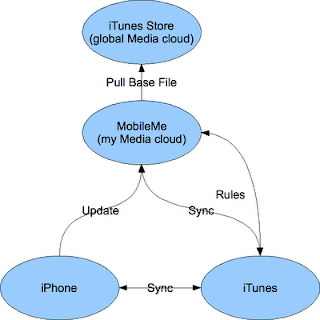
The UI side should be pretty simple for Apple as well, the Time Machine interface of multiple "levels" sounds like an ideal piece to replicate for a cloud browser, so you look at an album where you sync a track then "go back" to the full album then "go back" to all the albums you own by that artist. Throw in "genius" and Apple can start flogging you new tracks by indicating other levels that are available via the iTunes store.

What else could you do once you hit the cloud? Well things like Animoto show what cloud can do from a compute perspective, why not have that synced directly from your phone via MobileMe? View it then post directly to YouTube without requiring any additional local storage. You can decide to save it locally if you want but you still have the video in your overall cloud view of content.

So after then what do you need? Well HD video is liable to become more normal on compact cameras and where cameras go the phones follow, so why not HD on an iPhone next year? Again this hits the storage side but again having a cloud solution would mean that you could quickly offload it to the cloud. If you want to do some local edits (iMovie for iPhone?) then you get a transcoded short clip back, this lets you edit away on the device in the basic way. Upload to the cloud "iMovie" and a full HD rendered video is then available for your viewing or sharing.

Now of course what you need here is iMovie, and how do you get iMovie? Oh yes you have to buy a Mac, so you buy the iMovie4iPhone application (ala Keynote) and the iMovie4MobileMe subscription to give you a nice joined up experience. If you don't want the rendering pieces then its all included but you just have to sync from your Mac to create and view the final HD video.

So suddenly there are a few pieces on your iPhone that just seem to demand that your next computer is a Mac. Not because the iPhone just works, but because its really nice the way the two worlds synchronise via the cloud. Hell throw in TimeMachine via the cloud as a weekly offsite to go with your local daily and suddenly Apple are selling you a media cloud. Use Apple TV in your lounge to view all the stuff from this cloud and have it "just work". So you create a video on your iPhone, edited from lowres transcoded clips, this is then pumped via your main Mac as an HD version which you can then watch on your Apple TV.

So while people are clamouring for lots more whizbang elements on the device we thought that this missed the point. The iPhone isn't technically the most advanced device out there, its just the best device for users. Asking for forward facing cameras and other technical gizmos which would mean the iPhone would match other devices on a tickbox misses the reasons why it is the current leader in its space.

The opportunity for Apple here is to use the cloud, and in particular MobileMe, as the central co-ordination point between all your media life. Apple should be able to commercialise that connection ($100 a year for this sort of functionality, I'd go for it) and can also use it to leverage themselves a stronger position in the home computer market.

Previously people had talked about the "central hub" in a home, whether it be MediaCentre or a PS3, the challenge with these is that they were always very physically centric solutions and they didn't move you as you left the building. A cloud solution gets rids of that problem and offers a whole heap of other opportunities.

Maybe Apple will go down the cram in the features route, but personally I hope they open their eyes to the world they've already created and look to leverage it in new an interesting ways. You can keep your 10 Mega Pixel camera, I want my media cloud.

Others can build clouds and hope that people will come, Apple can build a cloud that will have them queuing up to demand to be locked-in.


Technorati Tags: ,

Monday, July 21, 2008

Google Map Rolling on a Mac

I love "silly" demos that combine technologies. Raul Guiu has written a very small app that uses the Mac's motion sensor to navigate around Google Maps. Now my first thought was "nice demo, can't see an application" then I started playing "follow the roads" which was fun for a short period of time. Now however I can think of quite a few bits where adding in motion and GPS could really commoditise certain areas. Take the "Fitness Watch" market, it costs £100-£200 for a watch and the "premium" ones are those with GPS. Now however with my iPhone I already have a GPS but I need to combine the information. The motion sensor could also act as a pedometer as well as indicating on a bike how fast I am going and what sort of lean I got into the corners.

This sort of "personal network" approach (which runs against the "one central device" theory) would give me all of the information I need (and more) and do so over a very limited area (I have them on me, if I don't then they aren't involved).

Its something that I expect we will see more of as things like the iPod/Nike link up are expanded and players like Polar want to get into the act. The key here will be around the short network comms and not burning the battery to get that done.

So yes its just using a Mac to navigate a Map, but it does go to show that not all Mashups have to be of web information. Mashing up personal information in a localised way can be just as, if not more, useful.


Technorati Tags: ,

Friday, July 11, 2008

I hate technology, I love solutions

I've begun to realise something recently, I don't like technology. I love working in IT but its never the technology bits that get me excited, its always what you can do with them this is why I loathe discussions on "X is better than Y" as its really about what can you do with X and Y. Most of the time you can do the same thing, but maybe one of them makes it easier to reach the end goal.

This came home to me today when I took delivery of my lush new 3G iPhone. Seriously I've not been this excited about a gadget since the PS2 came out. The reason I like it isn't that its a smartphone or that its 3G, my work phone is 3G and its a smartphone and I loathe and detest it with a passion. No the reason I like it is because its such a damn smooth solution it just plain works. I don't care if they use Linux, OSX, Windows or Symbian, I don't care whether the applications "look the same" as the ones on my laptop (which is a Mac), I just care that it works and it gets the hell out of my way when I want to do things.

Oh but woe is me, the registration doesn't work their servers are getting canned and falling over. That is the technology part of the equation, someone somewhere hasn't scaled the infrastructure correctly and done the right sort of caching to make it all work. This first of all tells me I've been a complete sheep in buying the 3G iPhone because clearly there are loads of other people doing the same thing and secondly that technology breaks.

That is the difference, solutions are the bits that you use as an end-user. You only find out about the technology when it breaks.


Anyway its all gone through now and the bit I loved best.... when it rejected the default browser on my desktop VM because it fired up IE ;)

Technorati Tags: