A very short while ago I made a post about the
starting point for SOA and in the follow-up I made a comment that I wasn't a big fan of canonical data models, and I was asked to clarify why, so here goes.
First off lets agree what we mean by this and I'll take
this
Therefore, design a Canonical Data Model that is independent from any specific application. Require each application to produce and consume messages in this common format.
As the definition. I've seen, and led, quite a few projects that have used a canonical data model, and for some things its worked and for lots its failed (of course the ones I led were the ones that worked :) ). So its not that canonical forms are a really bad thing, its just that they aren't the ultimate solution.
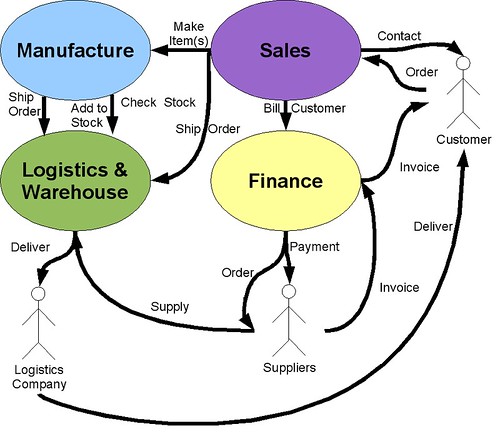
Taking the manufacturing service Level 0 as out start

and thinking about product and customer as our two data elements to worry about. There are three approaches here, all of which could be called canonical to some degree but which represent very different approaches to the solution.
Just the facts
The first is the one I've used most often to success in this area, and its focus is all about the interactions between
multiple services. The rule here is basically common demoninator, the objective is to find the
minimum set of data that can be used to effectively communicate between areas on a consistent basis. The goal here isn't that this should be used on 100% of occasions but that it represents 70-80% of the interactions.
In this model we might even get to the stage where its ProductID and CustomerID that are shared and we have a standard provisioning approach for the two to ensure that IDs are unique. But most often its a small subset that enables each service to understand what the other is talking about and then translate it into its own version. So in this model the "canonical" form is very small, really just a minimal reference set. This does mean that sometimes conversations have to take place outside of this minimal reference set, and that is fine, but its more costly so the people making that call need to be aware that now they are completely responsible for managing change of that interaction.
So in this model we might say that all product elements are governed by the productID, customer consists of Name and Address, but when sales talk to finance to bill a customer for an order they also include the product description from their marketing literature to help it make sense on the invoice. Here we would model this extra bit of information either as an extension to the previous data model, or just consider it bespoke for that transaction. This would mean that the sales service team would now be responsible for the evolution of that data description rather than using the global model which would be owned and maintained... well globally. The objective when communicating is to use this minimal reference set as much as possible, as this reduces effort, and the goal of the team that maintains it is to keep it small so its easier for them.
This model is paticularly effective in data exchange projects like reporting or on base transactional elements, but its the one I've seen used most effectively especially when combined with strong governance and enforcement around the minimal reference set. A great advantage of this model is that it reduces the risk of work being done in the wrong place, if all you have is CustomerID you are unlikely to undertake a massive fraud profiling project, something better off left to finance.
When you talk, we listen
The next approach, and already getting into dangerous territory IMO is to create a
superset of all interactions between services. In this world the goal is to capture a canonical form that represents 100% of the possible interactions between services. Thus if a service
might need 25 fields of product information then the canonical form has those 25 fields. The problem with this model is that there is a lot of crap flying about that is just there for edge cases. It can be made to work but it makes day-to-day operations harder and tends to lead to blurring of boundaries between areas/services and increases the risk of duplicate functionality. Its also a real issue of information overload. What I've tended to see happen in this model is that people start adding fields "incase" to the model and also start consuming and operating on fields "because they can". This isn't sensible.
I'd like my project to fail please
The final approach is the mythical "single canonical form" this beast is the one that knows everything, its like
enterprise but even worse. This one creates a
single data model that represents not only the superset of interactions, but the superset of
internals as well. So it models both how finance and manufacturing view products and lobs them together, considers how sales and distribution view customer and lobs them together. Once this behemouth is created it then mandates this as the interaction between the areas with (in my experience) disasterous consequences. Its too complex, it removes all boundaries and controls and it ends up with ridiculous information exchanges where both parties known how internally the two areas operate. When external parties are brought into the mix it gets ever more complicated and fragile.
Summary
So I'm not 100% against canonical in terms of an intermediary for data exchange, but I do think that a canonical form needs to be kept very small and compact and that exchanges outside of that canonical form must be allowed for and managed. In the same way as there isn't an enterprise service bus that does everything there is equally no single canonical form that works everywhere. Flexibility comes from mandation for certain elements and increased costs for stepping outside, but stepping outside has to be allowed to enable systems, people and organisations to operate effectively.
Technorati Tags: SOA, data modelling, Service Architecture